
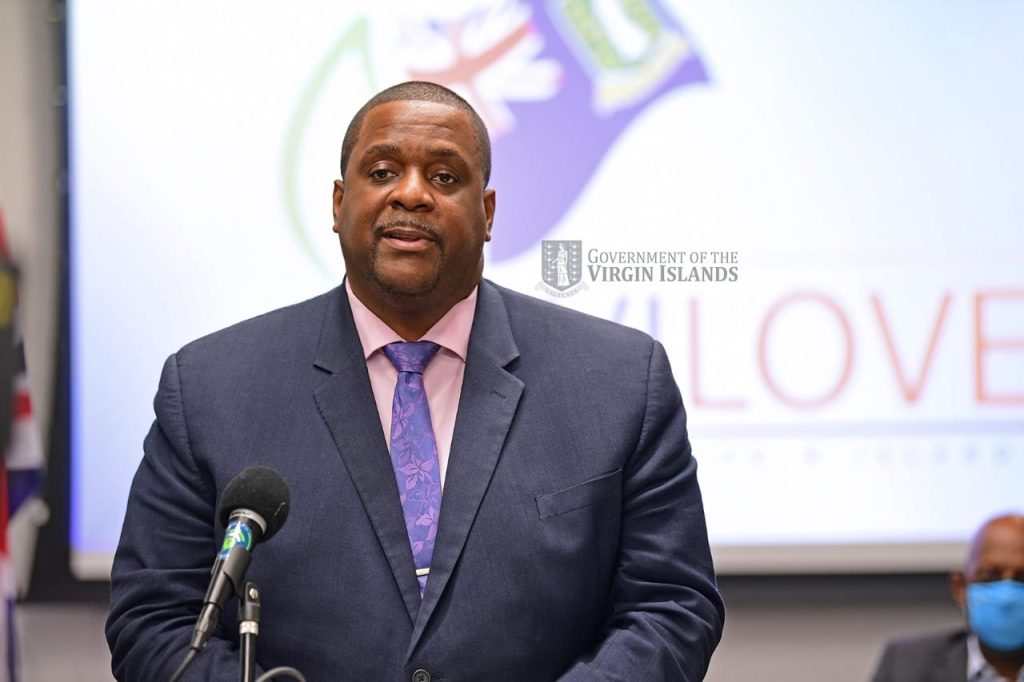
Attorneys for former British Virgin Islands Premier Andrew Fahie are renewing their effort to overturn his federal cocaine-smuggling conviction, arguing before a U.S. appeals court that federal agents gave misleading and contradictory testimony about a key confidential informant.
Fahie was convicted in February 2024 after undercover U.S. Drug Enforcement Administration agents posed as members of a Sinaloa drug cartel and investigated a fictional plan to use the British Virgin Islands as a transshipment point for thousands of pounds of cocaine destined for the United States.
Prosecutors presented secretly recorded conversations in which Fahie appeared to participate willingly in the proposed operation. The investigation also involved the BVI Ports Authority director and her son.
Fahie’s attorneys, however, are not disputing his participation in the conversations as part of the appeal. Instead, they are challenging the conduct and credibility of federal agents involved in the investigation.
At issue is a confidential informant who had previously been involved in a 2018 public-corruption investigation in Mexico. According to court records, Mexican judges ultimately found the informant lacked reliability, and information provided by the operative was not used.
During Fahie’s trial, a supervising federal agent initially testified that he did not know about the Mexican court’s concerns regarding the informant until after Fahie’s April 2022 arrest.
The testimony became increasingly contentious when the trial judge questioned the agent outside the presence of the jury.
The judge repeatedly pressed the agent to answer whether he had known in 2018 that a foreign judge had found the confidential informant lacked credibility.
The agent ultimately answered, “Yes, your honor. My apologies.”
When questioned again in front of the jury, however, the agent said he had not learned about the finding before May 2022. He said investigators discovered the information while conducting media searches in preparation for Fahie’s case and could not recall exactly when the search occurred.
The judge continued to press the agent about what he knew during the 2018 Mexican case. The agent acknowledged having “general information” about the situation and said a partner had participated in the matter.
Fahie’s attorneys contend the conflicting testimony was more than a simple memory lapse.
In filings with the 11th Circuit Court of Appeals, they accused the agent of deliberately concealing his prior knowledge and characterized the testimony as perjury.
“This pattern of concealment and false or misleading testimony goes directly to the reliability of the sting itself,” Fahie’s attorneys argued, adding that the conduct amounted to a violation of the Fifth Amendment’s guarantee of fundamental fairness.
The defense is asking the appeals court to dismiss the case based on what it describes as “outrageous government conduct,” a rarely invoked legal doctrine that can provide grounds for dismissal when government conduct is considered fundamentally improper.
The appeal also challenges another piece of testimony from an undercover agent concerning the cocaine used in the fictional operation.
According to the defense, the agent testified that the supposed cocaine had been prepared so that it would not test positive for cocaine until it was processed on the U.S. mainland.
Fahie’s attorneys argue that if the substance would not have tested positive for cocaine in its original form, the government could not establish an essential element of the offense, that the substance imported contained a detectable amount of cocaine.
The prosecution’s case centered on Fahie’s alleged willingness to facilitate the movement of cocaine through the British Virgin Islands, despite the drugs being part of a fictitious sting operation.
Fahie, who was the BVI’s premier and one of the territory’s most powerful elected officials at the time of his arrest, was detained in April 2022 following the undercover investigation.
His attorneys are now asking the 11th Circuit to reverse the conviction, arguing that the government’s conduct and the agents’ testimony undermine the integrity of the prosecution.
The appeals court had not indicated when it would rule on Fahie’s appeal.